
Should you buy HVAC leads? Shared leads, Local Services Ads or your own lead flow

Kevin van Geffen
Published

Every spring and fall, the same question lands on a lot of HVAC owners’ desks: should we just buy leads to fill the slow weeks? It is a fair question. You run trucks, techs and a dispatch desk, and you need booked jobs now, not in six months. The short answer is this: buying shared leads can fill a gap for a short time, but it should not be your main engine. For most Canadian heating and cooling companies, the better plan is to test Google Local Services Ads first, then build a system around calls and jobs you own.
Below we compare four ways to get enquiries, without naming any company. We explain who else gets the lead, who you pay, and what you keep when you stop. A quick note on where we stand: we are a marketing team, not a lead seller. We never sell leads. The work we do helps you win your own calls and booked jobs. If you want our service page on this, start with HVAC lead generation.
Who is this article for, and who is it not for?
This article is for owners and general managers of Canadian HVAC companies who are deciding whether to buy leads, run their own ads, or do both. It is not written for homeowners, and it is not a buying guide for any one platform.
This is for you if:
- You run anywhere from one truck to several crews of techs.
- You do mostly residential service and replacement: furnaces, air conditioning, heat pumps, boilers, water heaters and indoor air quality.
- You have felt the sting of a shared lead that six other contractors also got.
- You want more booked jobs from your own service area, not rented contacts.
This is probably not for you if:
- You are a homeowner looking for a contractor.
- You are a commercial-only shop with no residential service work.
- You want a one-click way to buy a stack of leads and nothing else.
What are the four ways to get HVAC enquiries?
There are four common ways Canadian HVAC contractors get enquiries: shared marketplace leads, Google Local Services Ads, Google Search Ads to your own website, and your own lead flow from local search, your Google Business Profile and reviews. Each one differs on competition, who you pay, and what you keep when you stop paying.
Here are the plain-language terms first:
- Shared leads: a homeowner posts a job on a marketplace, and several contractors can get or buy the same contact.
- Local Services Ads (LSAs): ads at the top of Google where you pay per valid call or message instead of per click.
- Search Ads: ads on Google search results where you pay per click to your own website.
- Your own lead flow: calls and forms that come to your brand through unpaid local search, your Google Business Profile (your free Google listing on Search and Maps) and your reviews.
| Lead source | Who else gets it | Who you pay | What you keep if you stop |
|---|---|---|---|
| Shared marketplace lead | Several contractors can get the same contact | The marketplace | Nothing; the volume stops |
| Local Services Ads | The homeowner can still call others, but the lead comes only to you | Google directly | Your reviews and profile stay; the ad placement stops |
| Search Ads to your site | Only you get the click and the form | Google directly | Your website, tracking and data stay; the clicks stop |
| Your own lead flow | Homeowners see competing listings too, but call you directly | Your own time and your marketing team | Your website, Business Profile, reviews and customer records |
Should you buy shared HVAC leads?
Shared leads work best as a short-term filler, not as your main source of booked jobs. You can get access to demand fast, but you are often competing on price and speed with several other contractors who received the same contact.

Here is the trade-off in owner terms. A shared lead can be cheap per lead, but the booking rate is usually low because the homeowner is talking to several of you at once. You can still pay even when you do not win the job. And the day you stop paying, the volume disappears, because you never owned the source.
Good times to use shared leads:
- A slow shoulder season when crews have open capacity.
- A brand-new service area you are testing.
- Filling a gap while you build your own visibility.
Poor times to use shared leads:
- As your only source of work.
- During a no-heat cold snap when you are already fully booked.
- When the leads are out of your service area or the wrong job type.
Before you sign anything with a marketplace or a lead seller, ask these due-diligence questions:
- Is this lead exclusive to me, or how many contractors can get it?
- What exact event creates a charge: delivery, shortlist, an answered call, or a booked job?
- Can I reject wrong-service, duplicate, spam and out-of-area leads?
- Is there a published rate, or can fees change without my approval?
- Can I export every lead with its source and timestamp?
- Is there a minimum term, auto-renewal or cancellation fee?
Are Google Local Services Ads worth testing first?
Google Local Services Ads are usually the first paid channel worth testing for urgent HVAC demand, because you pay per valid call or message and the lead comes directly to you. A homeowner with no heat in January needs help fast, and these ads sit right where that search happens.
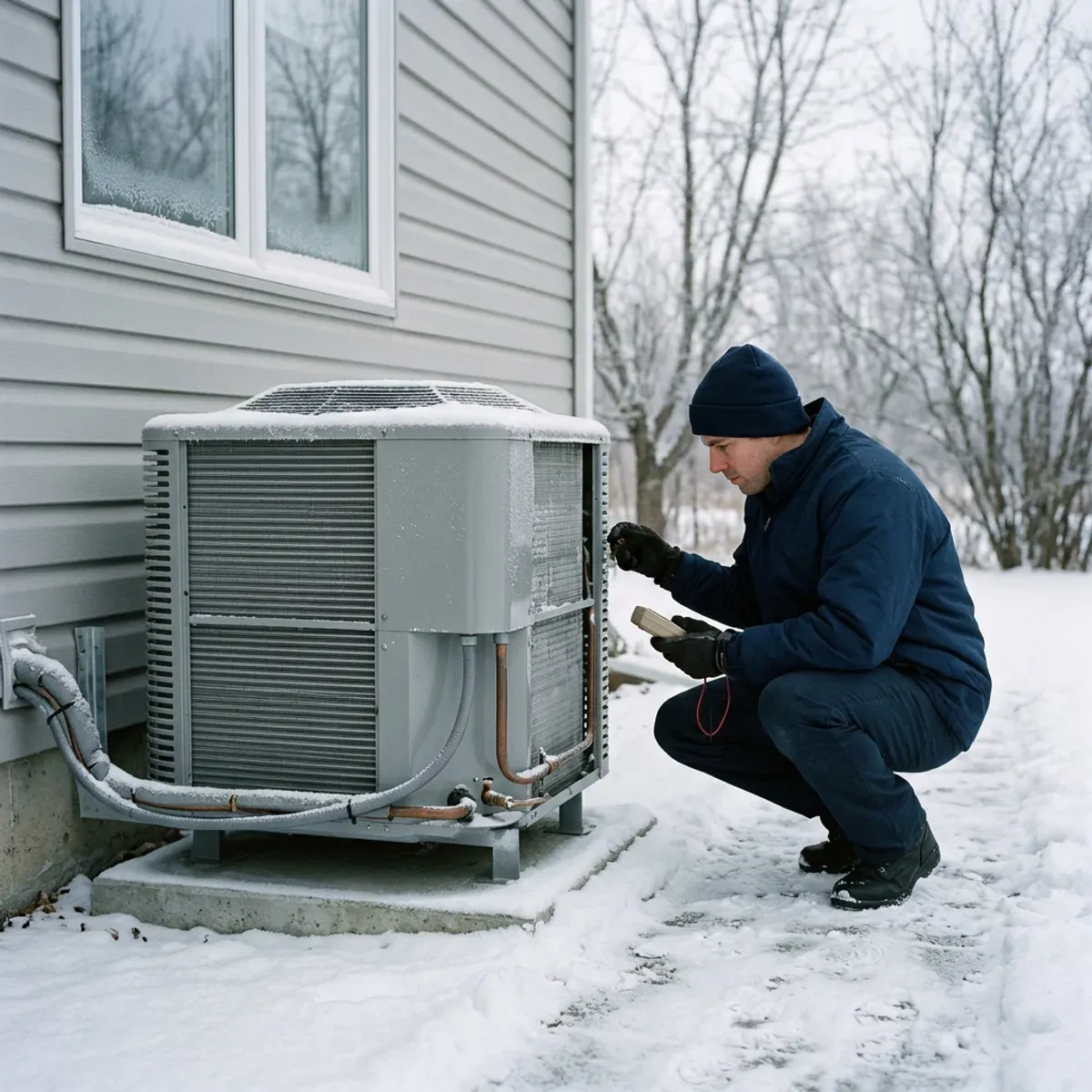
With LSAs, you show up at the very top of Google for local searches. The homeowner picks your profile and contacts you. They can still call other contractors, but Google does not hand the same enquiry to a shortlist of competitors the way a marketplace does. Google explains how Local Services leads and charges work, and you can see the Canadian product on Google’s Local Services Ads page for Canada.
A few facts to keep in mind, from Google’s own pages:
- The badge is now Google Verified. Google uses this one badge for all Local Services advertisers and has discontinued the Money Back Guarantee that came with the older Google Guaranteed badge (Google on the Google Verified badge).
- Credits are automatic and limited. Google screens leads and can credit low-quality ones automatically, but it no longer gives credits for leads outside the job types or areas you serve (Google on lead credits). Keep your service areas and job types tight.
LSAs still take work. You need reviews, a verified profile and fast responses. A charged lead is not the same as a booked, profitable job. If you want us to set up and manage this for you, see Local Services Ads management for HVAC.
What is your own lead flow, and why does it matter most?
Your own lead flow is every call and form that comes to your company through your website, your Google Business Profile and your reviews. It matters most because you keep these assets when you stop any paid campaign, and they make every paid channel work better.

Think of it as the difference between renting and owning. With shared leads, you rent access. With your own lead flow, you build something that keeps producing calls. Your website and your customer records are yours. Your Business Profile, reviews and rankings live on Google’s platform, so they are not fully in your control, but they still belong to your brand, not a middleman.
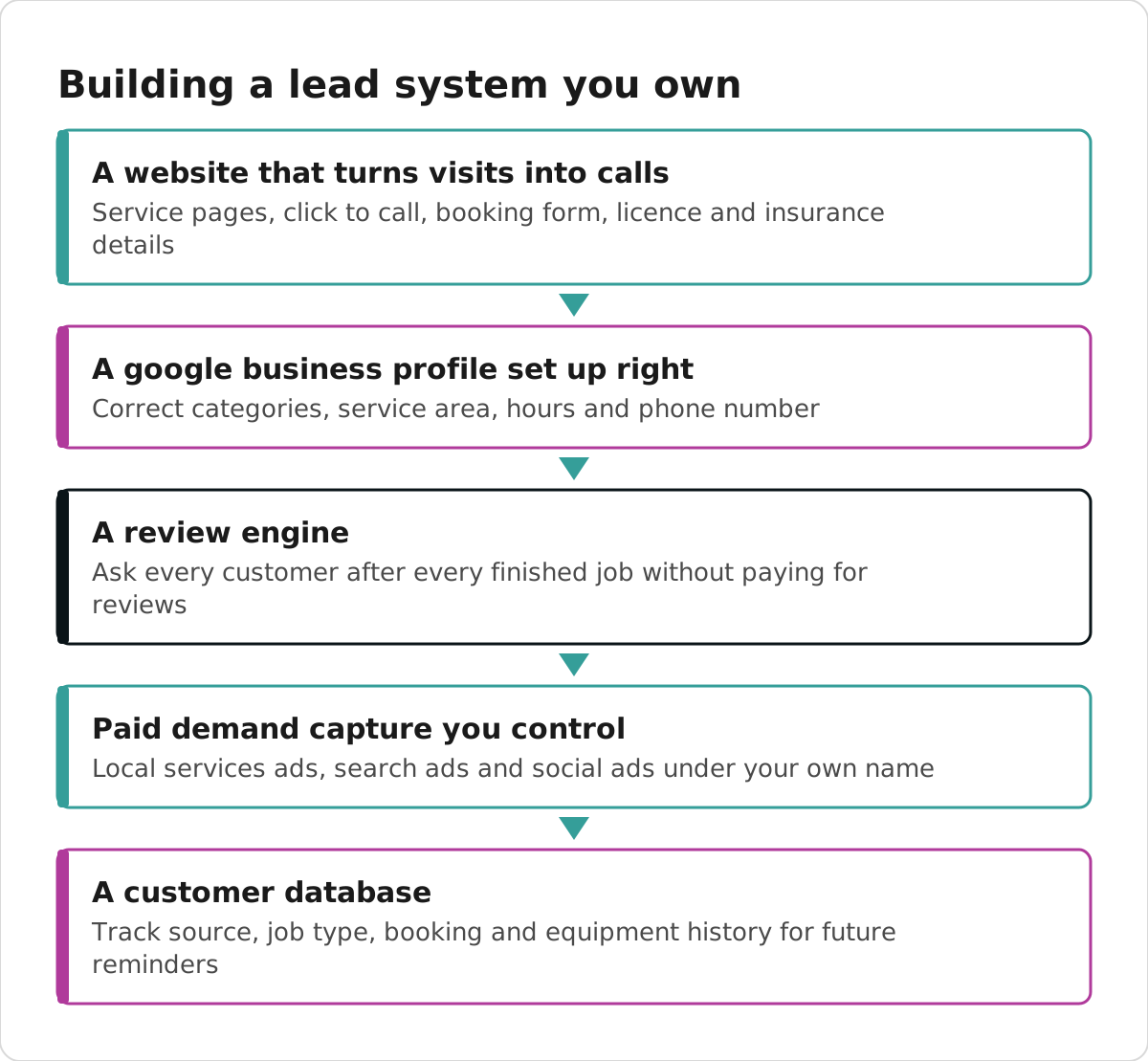
A solid owned system has five parts:
- A website that turns visits into calls. Separate pages for furnace repair and replacement, AC, cold-climate heat pumps, boilers, water heaters and indoor air quality, with a click-to-call button, a short booking form, your real hours and your licence and insurance details.
- A Google Business Profile that is set up right. Correct categories, service area, hours and phone number so the right homeowners find you on Search and Maps.
- A review engine. Ask every customer after every finished job. Do not pay or offer discounts for reviews; Google does not allow incentivized reviews (Google review policies). A simple setup works well: a short review link on your website, QR cards your techs hand out after a job, and a thank-you email for finished projects.
- Paid demand capture you control. LSAs and Search Ads for urgent work, and Meta ads for planned installs, maintenance plans and remarketing, with every account under your name.
- A customer database. Store source, job type, booking and equipment history so you can send tune-up and replacement reminders instead of always buying net-new leads.
Building unpaid local visibility takes time. We plan on 6 to 12 months before SEO results are meaningful. That is our planning range, not a promise.
How should you compare channels? Not on cost per lead alone
Never judge a lead source on cost per lead alone. A cheaper lead that rarely books is more expensive than a pricier lead that turns into a job. Compare channels on cost per booked job and on gross profit after marketing.
You can see why the cheapest lead is not always the best deal. Track these for every channel:
- Booking rate: booked appointments divided by valid leads.
- Cost per booked job: total channel cost divided by booked jobs.
- Gross profit after marketing: collected revenue minus equipment, labour and acquisition cost.
Then split the numbers by repair versus replacement, by furnace versus AC versus heat pump, and by service area. There is no reliable public figure for what an HVAC lead costs in Canada. Prices vary by market, job type and season, so be wary of any national number. For our own pricing, use the calculator on the pricing page.
What about email and text follow-up?
If you follow up by email or text, you must follow Canada’s anti-spam law, known as CASL. In plain terms, you generally need consent before you send commercial messages, you must identify your company, and you must include a working unsubscribe option. An enquiry can create limited implied consent for a set time, but buying an email list does not transfer anyone’s consent to you. The core rules are federal, so they do not change by province. Keep your consent records, and read the law itself before you run any campaign.
Common mistakes HVAC owners make with leads
- Buying more leads when calls already go unanswered. Fix call handling first, then add leads.
- Judging everything on cost per lead. Look at cost per booked job instead.
- Letting an agency keep the accounts. If you cannot get admin access to your Ads, Analytics, Business Profile, website and call tracking, you do not own the system.
- Signing a long contract with a company that also markets the shop down the street. We take one HVAC company per service area, so we never also market the HVAC company down the street from you.
- Running paid campaigns flat out during a cold snap. When you are fully booked, pause or narrow paid acquisition and protect your response times and your existing customers.
Your next step: a short checklist
Use this checklist to decide where to put your money:
- Can your trucks and dispatch handle more calls this week? If not, fix call handling before buying leads.
- Is your Google Business Profile complete and accurate?
- Are you asking every customer for a review after every finished job?
- Do you own your website, domain, ad accounts and call tracking?
- Have you tested Local Services Ads for urgent furnace, AC and heat pump demand?
- Are you tracking cost per booked job, not just cost per lead?
- Do you have a plan to build unpaid local visibility over the next year?
If you check the first few boxes, you are ready to shift spending away from shared leads and toward assets you own. The founders set every client’s strategy and stay in charge of the work and its quality, and our team keeps the reporting in plain words so you always see calls, booked jobs and cost per job.
When you are ready, check if your area is open. We only work with one HVAC company per service area, so availability depends on your town.